
C++ Storage Classes

Declaration & Assignments
C++ Storage Classes

Storage class are used to specify control two different properties: storage life-time and scope(visibility) of variables.
Following storage classes can be used in a C++ Program:
  • Automatic
  • External
  • Static
  • Register

Automatic(auto) Storage Class

Variable defined within the function body are called auto variable. The auto storage class is used to declare automatic variables, which is also called local variables.
Example:
auto int a, b, c = 100;
is same as:
int a, b, c = 100;

The External Storage Class

External variables are defined outside of the function. Once External variable declared, the variable can be used in any line of codes throughout the rest of the program.
The extern modifier is most commonly used when there are two or more C++ files sharing the same global variables or functions.
First File : main.cpp
Example:
#include <iostream>
#include "file.cpp"
int count ;
extern void write_extern();

main
()
{
count
= 5;
write_extern
();
system
("PAUSE");
}
Second File : file.cpp
Example:
#include <iostream>
extern int count;

void write_extern(void)
{
std
::cout << "Count is " << count << std::endl;
}
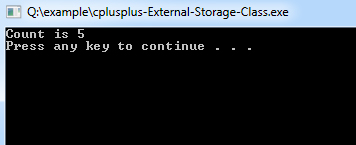
Program Output:
cplusplus-External-Storage-Class

Comments

For Programs Click Here

Popular posts from this blog

Python Lists

Python Lists Dealing with data in a structured format is quiet generous, and this is possible if those data are set accordingly in a specific manner. So, Python provides these data structures named ‘lists’ and ‘tuples’ that are used to organize data in  single set. Python has 6 built-in sequences and among them the most famous are “lists and tuples”. The lists are containers that hold a number of other objects in a given order. It usually puts into practice the sequence protocol and allows programmers to add or remove objects from that sequence. Each element of the sequence is assigned a number i.e. he index and the first index is 0 (zero). This versatile data-type of Python is written in a sequence of list separated by commas between expressions. Creating Lists To build a list, just put a number of expressions in square brackets. The syntax is: Syntax: lst1 = [ ] # lst1 is the name of the list lst2 = [ expression1 , …. , expression_N ] Example: #!/usr/bin/python ls...

Java Method Overriding

Java Method Overriding Declaring a method in the subclass which already exists there in the parent class is known as method overriding. When a class is inheriting a method from a superclass of its own, then there is an option of overriding the method provided it is not declared as final. The advantage of using overriding is the ability to classify a behavior that’s specific to the child class and the child class can implement a parent class method based on its necessity. There are certain rules that a programmer should follow in order to implement overriding. These are: In Java, a method can only be written in the child class and not in same class. Argument list should be exactly the same as that of the overridden method of that class. Instance methods can also be overridden if they are inherited by the child class. A constructor cannot be overridden. Final – declared methods cannot be overridden. Any method that is static cannot be used to override. The return type must have to be the...

C++ Data Abstraction

C++ Data Abstraction Object oriented programming offers various features to write programs with various concepts that help to minimize problems and increase flexibility in program. One of the features of object oriented programming is Data abstraction. In this chapter you will learn about how the concept data abstraction is carried out within the C++ program. What is Data abstraction? Data abstraction allows a program to ignore the details of how a data type is represented. Abstraction (derived from a Latin word  abs , meaning away from and  trahere , meaning to draw) refers to the act of representing essential features without including the background details or explanations. C++ classes use the technique of abstraction and are defined as a list of abstract attributes such as width, cost, size etc and functions to operate on these attributes. They put in a nutshell all the essential properties of an object that are required to be created. The attributes are therefore called...