C++ Constants

Declaration & Assignments


C++ Constants

Constants are like variable, except that their value never changes during the program execution once defined

What are Constants?

Constants refer to as fixed values, unlike variables whose value can be altered, constants – as the name implies does not change, they remain constant. Constant must have to be initialized at the time of creating it and new values cannot be assigned later to it.
  • Constants are also called literals.
  • Constants can be any of the data type.
  • It is considered best practice to define constants using only upper-case names.

Constant Definition in C++

There are two other different ways to define constants in C++. These are:
  • By using const keyword
  • By using #define preprocessor

Constant Definition by Using const Keyword

Syntax:
const type constant_name;
Example:
#include <iostream>
using namespace std;

int main()
{
const int SIDE = 50;
int area;
area
= SIDE*SIDE;
cout
<<"The area of the square with side: " << SIDE <<" is: " << area << endl;
system
("PAUSE");
return 0;
}
Run 
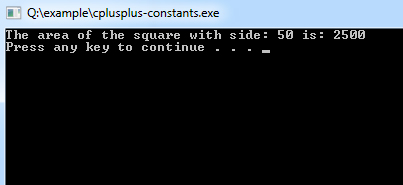
Program Output:
cplusplus-constants
It is also possible to put const either before or after the type.
int const SIDE = 50;
or
const int SIDE = 50;

Constant Definition by Using #define preprocessor

Syntax:
#define constant_name;
Example:
#include <iostream>
using namespace std;

#define VAL1 20
#define VAL2 6
#define Newline '\n'

int main()
{
int tot;
tot
= VAL1 * VAL2;
cout
<< tot;
cout
<< Newline;
}


Comments

For Programs Click Here

Popular posts from this blog

Java Method Overriding

Java Method Overriding Declaring a method in the subclass which already exists there in the parent class is known as method overriding. When a class is inheriting a method from a superclass of its own, then there is an option of overriding the method provided it is not declared as final. The advantage of using overriding is the ability to classify a behavior that’s specific to the child class and the child class can implement a parent class method based on its necessity. There are certain rules that a programmer should follow in order to implement overriding. These are: In Java, a method can only be written in the child class and not in same class. Argument list should be exactly the same as that of the overridden method of that class. Instance methods can also be overridden if they are inherited by the child class. A constructor cannot be overridden. Final – declared methods cannot be overridden. Any method that is static cannot be used to override. The return type must have to be the...

Syllabus

Syllabus  C Programming Tutorials C Tutorial C Introduction History of C Programming Language C Installation C Program Structure C Input and Output (I/O) C Format Specifiers Declaration & Assignments C Tokens C Identifiers C Keywords C Constants C Operators C Data Types C Variables C Preprocessors C Type Casting C Custom Header File Flow Control C Decision Making C if Statements C if-else Statements C Nested if-else Statements C else-if Statements C goto Statement C switch Statements C Loops C while loops C do while loops C for loops Functions C Functions C Function Arguments C Library Functions C Variable Scope Arrays & Strings C Arrays C Strings Pointers C Pointers C Dynamic Memory Allocation Structure & Union C Structures C Unions File I/O C File Handling C fopen C fclose C getc C putc C getw C putw C fprintf C fscanf C fgets C fputs C feof                                     ...

C++ Data Abstraction

C++ Data Abstraction Object oriented programming offers various features to write programs with various concepts that help to minimize problems and increase flexibility in program. One of the features of object oriented programming is Data abstraction. In this chapter you will learn about how the concept data abstraction is carried out within the C++ program. What is Data abstraction? Data abstraction allows a program to ignore the details of how a data type is represented. Abstraction (derived from a Latin word  abs , meaning away from and  trahere , meaning to draw) refers to the act of representing essential features without including the background details or explanations. C++ classes use the technique of abstraction and are defined as a list of abstract attributes such as width, cost, size etc and functions to operate on these attributes. They put in a nutshell all the essential properties of an object that are required to be created. The attributes are therefore called...