
C Arrays

                         Arrays & Strings

C Arrays

Array is a data structure in C programming, which can store a fixed size sequential collection of elements of same data type.

For example if you want to store 10 numbers then instead of defining 10 variables its easy to define an array of 10 length.
In the C programming language an array can beOne-Dimensional, Two-Dimensional and Multidimensional.

Define an Array in C

Syntax:
type arrayName [ size ];
This is called a one-dimensional array. An array type can be any valid C data types, and array size must be an integer constant greater than zero.
Example:
double amount[5];

Initialize an Array in C

Arrays can be initialized at declaration time:
int age[5]={22,25,30,32,35};
Initializing each element separately in loop:
int myArray[5];
int n = 0;

// Initializing elements of array seperately
for(n=0;n<sizeof(myArray);n++)
{
myArray
[n] = n;
}

A Pictorial Representation of the Array:
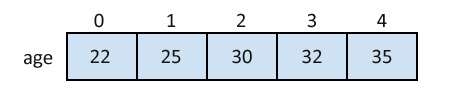
One-Dimensional-array

Accessing Array Elements in C

Example:
int myArray[5];
int n = 0;

// Initializing elements of array seperately
for(n=0;n<sizeof(myArray);n++)
{
myArray
[n] = n;
}

int a = myArray[3]; // Assigning 3rd element of array value to integer 'a'.

Comments

For Programs Click Here

Popular posts from this blog

Python Lists

Python Lists Dealing with data in a structured format is quiet generous, and this is possible if those data are set accordingly in a specific manner. So, Python provides these data structures named ‘lists’ and ‘tuples’ that are used to organize data in  single set. Python has 6 built-in sequences and among them the most famous are “lists and tuples”. The lists are containers that hold a number of other objects in a given order. It usually puts into practice the sequence protocol and allows programmers to add or remove objects from that sequence. Each element of the sequence is assigned a number i.e. he index and the first index is 0 (zero). This versatile data-type of Python is written in a sequence of list separated by commas between expressions. Creating Lists To build a list, just put a number of expressions in square brackets. The syntax is: Syntax: lst1 = [ ] # lst1 is the name of the list lst2 = [ expression1 , …. , expression_N ] Example: #!/usr/bin/python ls...

C++ Objects and Classes

C++ Object Oriented C++ Objects and Classes In object-oriented programming languages like C++, the data and functions (procedures to manipulate the data) are bundled together as a self-contained unit called an object. A class is an extended concept similar to that of structure in C programming language; this class describes the data properties alone. In C++ programming language, class describes both the properties (data) and behaviors (functions) of objects. Classes are not objects, but they are used to instantiate objects. What is a class? A class is an abstract data type similar to ‘ C structure ‘. Class representation of objects and the sets of operations that can be applied to such objects. Class consists of Data members and methods. Primary purpose of a class is to held data/information. This is achieved with attributes which is also know as data members. The member functions determine the behavior of the class i.e. provide definition for supporting various operations on data held...

C++ Polymorphism

C++ Polymorphism The term Polymorphism get derived from the Greek word where  poly  +  morphos  where poly means many and morphos means forms. In programming background, polymorphism can be broadly divided into two parts. These are: Static Polymorphism Dynamic Polymorphism. Polymorphism is another concept of object oriented programming (OOPs). The attitude which lies beneath this concept is “single interface having multiple implementations.” This provides a single interface for controlling access to a general class of actions. Polymorphism can be gained in both ways: compile time and run time A common and simple example of polymorphism is when you used  >>  and  << as operator overloading in C++, for  cin  and  cout  statements respectively. This bitwise shift operator at that time acts as a inclusion operator and its overloaded meaning is defined in  iostream  header file. Static Polymorphism In static polymor...